
About the Center
The meaning of the center's name
“Karma Thegsum Chöling” is a Tibetan name meaning “Place of the Buddha’s Teaching of the Three Vehicles of the Karma Kagyu Tradition.” The name of our parent center, “Karma Triyana Dharmachakra,” has the same meaning in Sanskrit.
Karma refers to the Karma Kagyu lineage, sometimes known as “the practice lineage” because of its emphasis on meditation.
Thegsum: “Theg” (proununced Tek) means “vehicle” and “Sum” means “three”; thus, the KTC teaches all three “vehicles” (or yanas) of Buddhism: Hinayana, Mahayana and Vajrayana.
Chöling: “Chö” means Dharma and “Ling” means place.
An extraordinary place for practice


Visiting KTC
The Albuquerque KTC is located at 139 La Plata Road NW, in Albuquerque, New Mexico.

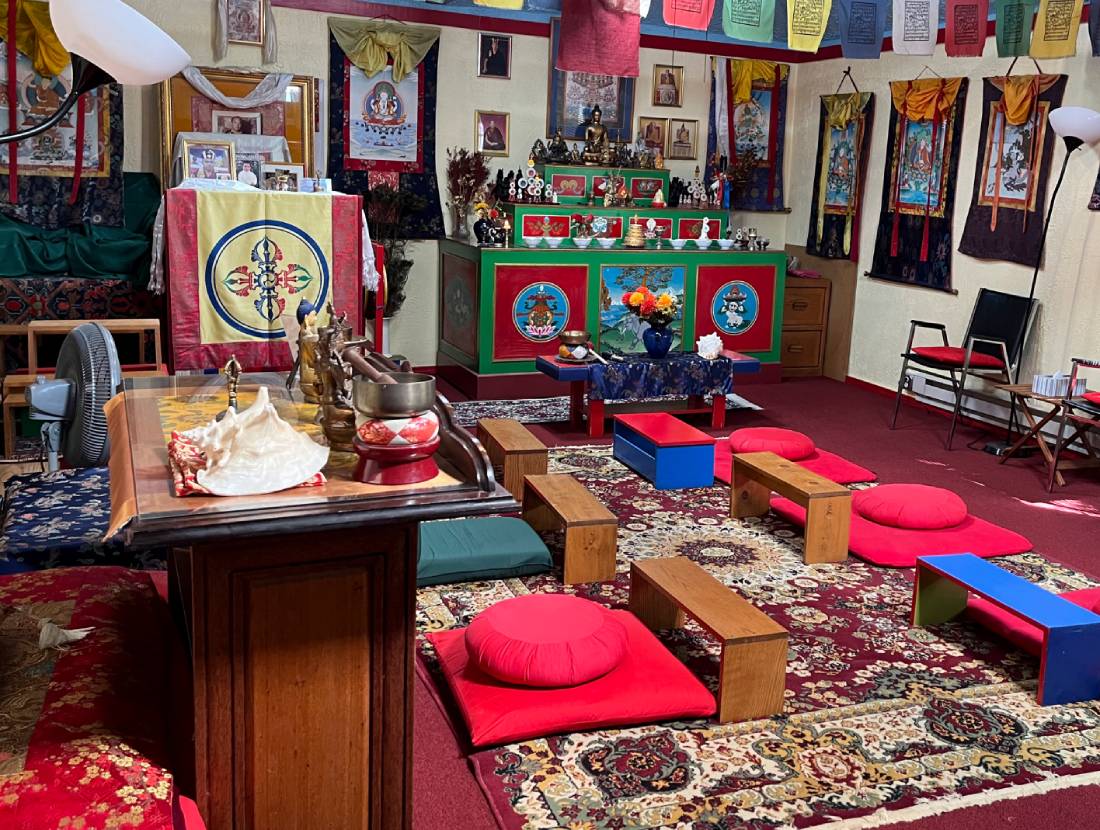
KTC is located in the building behind the house located at 139 La Plata Road NW. Visitors are welcome, but please note that KTC is not staffed every day, and does not hold regular hours during the week. Therefore, if you wish to view the shrine room, or ask about the center, it’s best to call and set up an appointment. Experienced practitioners who wish to participate in a sadhana practice, see the sadhana schedule on the calendar. At other times, the grounds are open for visitors but the library and shrine room are closed.
Things to know when visiting:
- the front house is not part of KTC
- please do not disturb the residents of the house
- please do not block or park in the west part of the driveway.
La Plata Road is three blocks north of Montaño Road, off of Second Street. From Interstate 25, exit at Montaño Road and head west (toward the Rio Grande river) to 2nd Street. Then turn right (north) on 2nd St. and go three blocks. La Plata is the third street on your right. The center is behind the second house on your left (north side of the street).
Bus stops within four blocks of the KTC include bus 157 (Montaño, Uptown, Kirtland), bus 10 (North 4th St., and the Montaño Transit Center, which is also a RailRunner train stop.
Please park on the street and walk up the gravel driveway to the center. However, please do not park in front of the storage unit facility, which is just opposite of 139 La Plata. The manager of the facility has threatened to tow any vehicles parked in front of it.
Guidelines for College Students

Students enrolled in a religious studies course at UNM or CNM are welcome to visit KTC to fulfill their course requirement of attending a religious ceremony. You may take notes, and questions may be asked before or following the ceremony.
Sunday Mornings: Traditional Tibetan Buddhist Sadhana Practice
A traditional Tibetan Buddhist liturgy called a sadhana is held every Sunday morning at 9:30 AM, which lasts about an hour. This is a chanted practice that is mostly in Tibetan. A meditation session begins shortly after the sadhana. Visitors are welcome to attend either or both practices.
Shrine Room Etiquette
Basic Guidelines for Temple Visits
Attire and Conduct
Dress should be respectful, similar to when one visits a Christian church on Sunday. Shoes are removed before entering the shrine room. Please avoid wearing strong scents or perfumes, as they can cause allergic reactions for some people, and can disturb meditators as they can cause unpleasant or distracting reactions for some people.
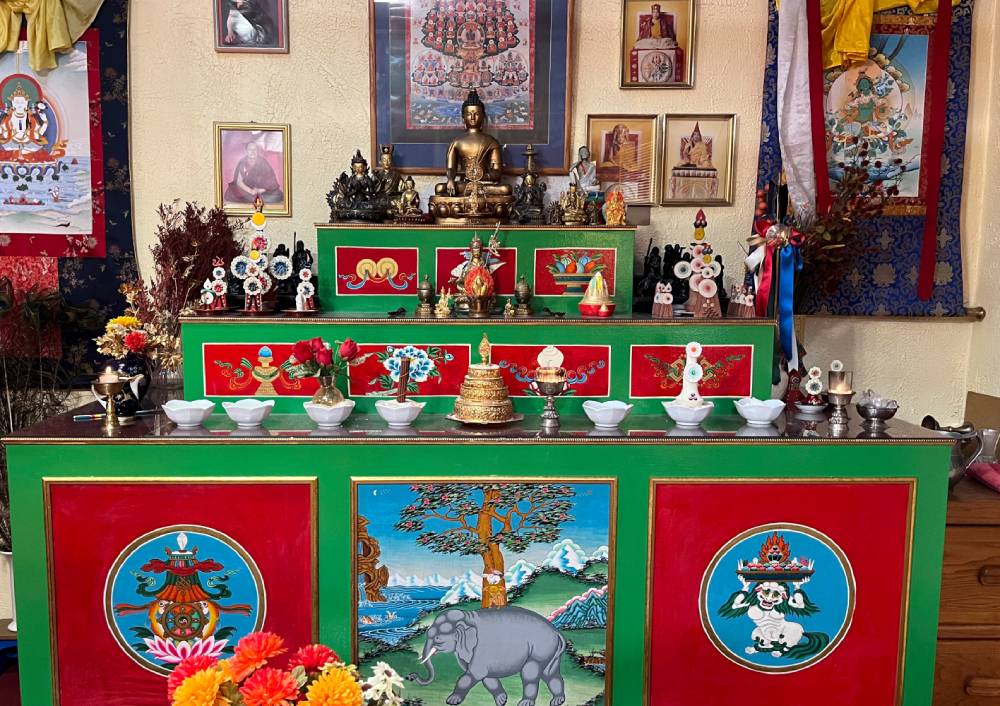
When entering the shrine room, a Buddhist practitioner may do three prostrations facing the shrine, or make a short bow with hands folded. This is done as a sign of deference to the the sources of our teachings and practices, and of our desire to benefit all beings.
Inside the Shrine Hall
- Conversation should be kept to a minimum in and around the shrine room when people are meditating or practicing.
- Dharma materials, practice texts & dharma books should be kept off the floor and places where people sit, but placed on a table or cushion, and should not be stepped over
General Behavior
- Do not sit with legs outstretched in the direction of the altar or a teacher, and avoid lying down
Show respect and kindness in manner of speech, thoughts and actions toward others present.
Behavior toward the Lama
Greeting
As a greeting in Tibetan tradition, a kata (silk scarf) is often handed to a lama upon their arrival or at the conclusion of their teachings. He/she will then return the kata to us by placing it around our neck and give us a blessing.
Before the teaching
Please arrive early, so as not to disturb the class once it has started. It is best to sit quietly, placing yourself in a calm, receptive state of mind.
Teacher’s entrance and exit
Stand when a teacher enters or leaves a room. It is also typical to bow slightly towards the teacher with hands together in prostration at the heart.
Membership in the Albuquerque KTC
Membership dues support both our local activities and the ongoing work of the Karma Kagyu lineage in America. The Karmapa has said explicitly that a direct spiritual connection exists between himself and KTC members. If you would like such a connection, please consider joining the Albuquerque KTC.
There are several types of membership available:

For Individuals
- Local KTC Member only: $15 per month.
- Joint Member of KTC and KTD: $33 per month.
For Families
- Joint Family Membership with KTC and KTD: $49 per month.
- Local Family Membership in the KTC only: $25 per month.
Members get discounts to events, and can check out materials from our library. Joint KTC-KTD memberships also include discounts at the many teachings held at KTD, and discounts on books and other items at the KTD bookstore, Namse Bangdzo, which also maintains an online store.
If you’re interested in becoming a member, please contact us at 505-343-0692 or info@abqktc.org, or come to one of our regular practices.
Our tax and legal status
Albuquerque Karma Tegsum Chöling is an “affiliate church” of our parent center, Karma Triyana Darmachakra (KTD). In addition, we are incorporated in New Mexico as a non-profit corporation, and are recognized by the U.S. Internal Revenue Service as a 501(c)(3) tax-exempt organization. All donations to Albuquerque KTC are fully tax-deductible, and will be put to use in our main activities of organizing teaching visits by lineage teachers and maintaining our facility as a supportive place for practice and study. Donations by check should be made out to “Albuquerque KTC” and either left at the center or sent to our mailing address:
Albuquerque KTC
P.O. Box 30335
Albuquerque, NM 87190-0335